Over the past few weeks, we’ve been speaking with concrete, aggregates and quarrying operators about the everyday challenges that slow down fleet operations. Whether running a small mixed fleet or managing dozens of vehicles across multiple sites, many of the same issues kept appearing.
The conversations revealed something interesting. The biggest challenges weren’t usually about vehicles themselves. They were about information, communication and visibility.
Taken together, these themes paint a clear picture of what modern construction fleet management looks like and where many operators are finding opportunities to improve efficiency, safety and service levels.
It Starts with Information, Not Vehicles
Ask where the friction exists in a busy construction fleet and most operators won’t talk about vehicle numbers, engine performance or payload capacity.
Instead, they’ll talk about information.
GPS locations, delivery schedules, job progress, allocation updates and customer requests all exist somewhere within the business. The problem is that they often sit in separate systems, on paper, or in conversations between different people.
A driver’s update goes one way, a planner’s schedule goes another, and the customer waiting for a delivery is often left waiting for answers.
When information isn’t connected, small delays quickly become larger operational problems. What should be a straightforward concrete delivery or aggregate collection becomes a series of phone calls, status checks and reactive decisions.
Communication is the Mechanism, Not a Nice-to-Have
One theme emerged repeatedly: effective communication is often the difference between a smooth operation and a frustrating day.
Many operators still rely on a combination of phone calls, text messages and paper dockets to keep work moving. While these methods may seem familiar, they can quickly become difficult to manage as fleets grow and workloads increase.
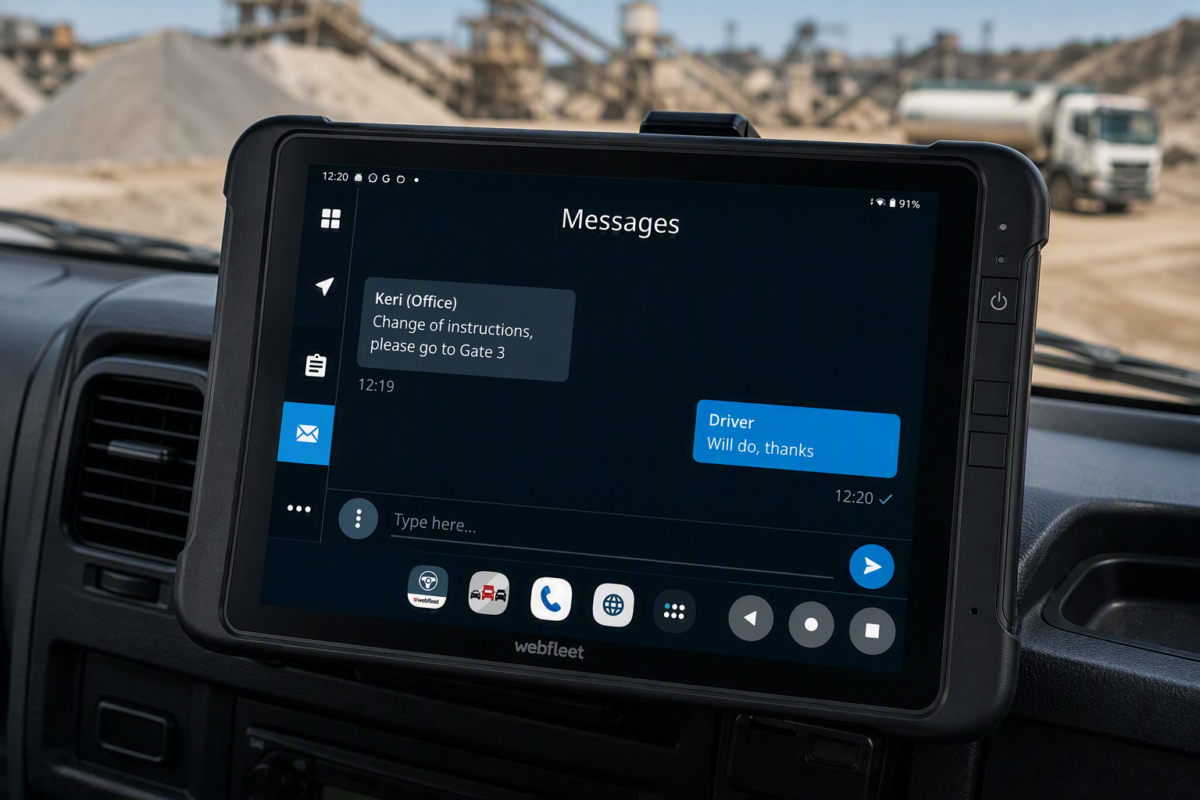
The most successful operators are finding ways to bring driver and dispatcher communication into a single connected workflow.
Drivers receive updates the moment they’re issued. Dispatchers can see vehicle status without needing to call for updates. Changes to schedules, routes or deliveries are shared instantly with the people who need them.
A vehicle is delayed by traffic. A delivery slot changes. A load is reassigned to another driver. Instead of relying on multiple phone calls, everyone involved sees the update immediately.
That visibility helps reduce misunderstandings and keeps projects moving.
(For a deeper look at what communication breakdowns can cost construction businesses, read our article: When Communication Breaks Down, Construction Slows Down.)
Connected Job Data is What Makes it Stick
Good communication alone isn’t enough. If the information behind each job remains disconnected, inefficiencies still find their way into the operation.
This is where connected job data becomes important.
Linking order allocation, vehicle tracking, job scheduling and live ETAs creates a joined-up picture of what’s happening across the fleet.
Rather than simply discussing jobs more effectively, operators can manage them more effectively.
Dispatchers gain confidence that vehicles are in the right place at the right time. Customers receive more accurate delivery information. Drivers spend less time waiting for instructions or dealing with last-minute changes.
The result is fewer reallocations, fewer “Where’s my delivery?” calls and a smoother experience for everyone involved.
The Efficiency Win Nobody Expected
One of the most interesting observations from our conversations was how often visbility improvements delivered benefits beyond planning and communication.
Once operators gain better control of allocation, routing and job visibility, inefficiencies become easier to spot.
Empty running reduces. Unnecessary idling becomes more visible. Routes become easier to optimise. Fuel consumption improves.
These benefits have always been valuable, but they’re becoming increasingly important as organisations face growing pressure to report on sustainability performance.
For many construction businesses, Scope 3 emissions reporting is moving from a future consideration to a practical business requirement. Customers, tenders and major projects are increasingly asking for greater transparency around operational emissions.
Interestingly, the operators best positioned to respond are rarely the ones creating entirely new reporting processes. They’re often the businesses that already have strong operational visibility and simply need to extract the information they are already generating.
And Underneath All of it; Safety.
Every conversation eventually came back to the same topic; Safety.
Construction sites, quarries and concrete operations are busy environments where vehicles, drivers, contractors and pedestrians often work in close proximity.
Operators consistently highlighted the importance of reducing blind spots, improving vehicle visibility and ensuring incidents can be investigated quickly and accurately when they occur.
Giving drivers better visibility around the vehicle can help reduce risk in challenging environments. At the same time, clear video evidence provides operators with the information needed to understand incidents, protect drivers and resolve insurance disputes faster.
When an incident occurs, access to accurate information can mean the difference between days of uncertainty and a clear answer within minutes.
For many operators, that peace of mind is just as valuable as any efficiency gain.
The Thread Running Through it All
What became clear from every discussion is that these challenges rarely exist in isolation.
Improve communication without connecting the operational data behind it, and you’ve simply made the chaos move faster.
Reduce fuel consumption without improving visibility and safety, and you’ve optimised the wrong thing.
The operators seeing the greatest results are the ones taking a connected approach to construction fleet management, bringing together communication, job visibility, vehicle tracking, compliance, efficiency and safety rather than tackling them individually.
Each improvement strengthens the next.
Visibility is the Real Advantage
The conversations we’ve had with construction, concrete and aggregates operators all pointed to the same conclusion.
The fleets performing best aren’t necessarily the ones with the newest vehicles or the largest operations.
They’re the ones with the clearest visibility.
Visibility into where vehicles are. Visibility into the status of jobs. Visibility into how drivers, dispatchers and customers stay connected. Visibility into safety, efficiency and compliance.
When that visibility exists, decisions become easier, communication becomes faster and operations become more resilient.
And in industries where delays, downtime and disruption have a direct impact on profitability, that’s often what keeps work moving.
If any of these challenges sound familiar, you’re certainly not alone. Across these operations, the most successful fleets are often the ones with the clearest visibility into their vehicles, jobs and day-to-day operations. If you’d like to explore how greater visibility could support your operation, we’d be happy to talk it through.